
Egg Freezing & Embryo Banking
- Advanced Cryopreservation & Vitrification Protocols
- Ultra-rapid freezing for maximum cell survival rates
- Personalized programs for social and medical fertility preservation
- Secure, continuously monitored long-term storage facilities
Introduction
Egg freezing (oocyte cryopreservation) and embryo banking are state-of-the-art services for women and couples who want to protect and preserve their fertility. These services include safely collecting, freezing, and storing eggs or embryos for later use in IVF treatments. At Dr. Noopur's Florentine IVF, we provide high-quality freezing facilities led by Dr. Noopur Bajpai, ensuring safe preservation with the highest standards of care and confidentiality.
The Process
In egg freezing, a woman undergoes ovarian stimulation to produce multiple eggs. These eggs are then retrieved during a brief, pain-free outpatient procedure under light anesthesia, and frozen immediately using an advanced ultra-rapid cooling technique called vitrification. This ensures the eggs are preserved without ice crystal formation, protecting their quality for future use.
Embryo banking occurs during a standard IVF cycle. After fertilizing the retrieved eggs with partner sperm in our state-of-the-art laboratory, the resulting embryos are monitored and evaluated. The healthiest embryos are then frozen using vitrification. This process allows couples to plan future pregnancies without undergoing repeated ovarian stimulation cycles, and provides a valuable option for family planning on their own timeline.
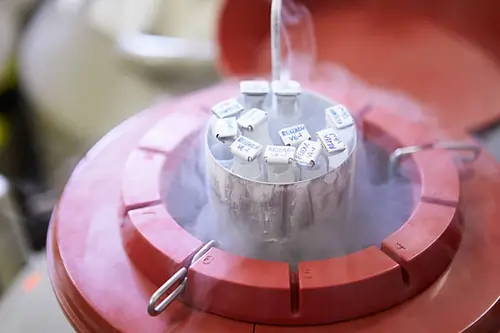
Both eggs and embryos are safely stored in liquid nitrogen tanks at extremely low temperatures, under continuous monitoring to ensure maximum safety and viability.
Is It Right for Me?
Egg freezing is a fantastic option for women who wish to preserve their fertility for personal or professional reasons (social freezing), or those facing medical treatments like chemotherapy that may impact future ovarian function. Embryo banking offers flexibility and peace of mind for couples undergoing IVF. Dr. Noopur and her dedicated clinical team will guide you through the options with complete privacy, compassion, and transparency.
FAQs
They can be stored safely for up to 10 years or even longer under optimal cryopreservation conditions, without any significant degradation in quality.
With modern vitrification (ultra-rapid freezing) techniques, the survival rate of cells upon thawing is exceptionally high (over 90%), maintaining success rates comparable to fresh cycles.
Absolutely. We follow strict protocols for quality control, identity verification, patient consent, and medical data privacy at every step.
Yes. Many successful pregnancies globally and at our centre have come from embryos that remained frozen for several years before transfer.